Westmarch
Westmarch is a walled city of some twenty-odd thousand people, built where the kingdom runs out and the Thornwood begins. The Westrun River flows through it from west to east and then turns north, cutting the wealthy quarter off from the rest. The city has stood over five hundred years, but it was made what it is three hundred years ago, when it became the keystone of the Greenwood Pact. Duke Aldric Westmarch rules it; his family has held it since the Pact was signed.
The western wall has no gate. It faces the forest, and it was built deliberately blind — a fact that has become a standing argument in city politics, and, the party now knows, a good deal more than that.
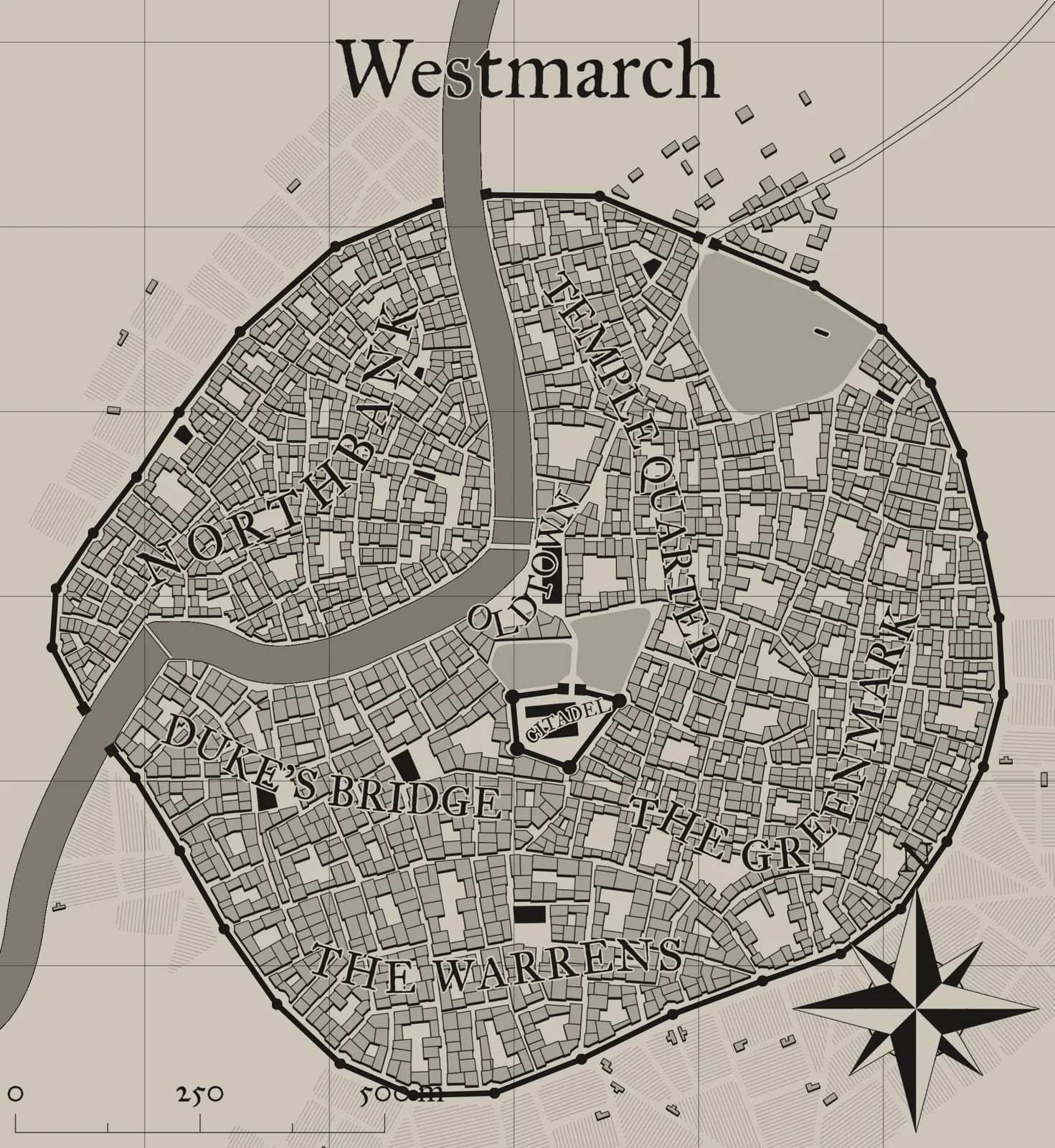
The seven districts
The Citadel. The stone heart of the city, where the Duke rules and his family lives. The party was received here, in a small room, on the night the Duke sent his guards away. Beneath it, the Duke says, is a stone only he can reach.
Oldtown. The oldest streets outside the Citadel, wrapped around it — working families, artisans, and the people who serve the court. The City Watch keeps its headquarters here, the Watchtower, under Captain Garrett Stone and Lieutenant Kessa Ironfoot.
Temple Quarter. Clean, quiet, and lettered. All five great temples stand here, along with the Archive of Ioun, where Quill works under Chief Archivist Elara. The Platinum Basilica of Bahamut — hospital, orphanage, Drakov's temple — is here too.
Duke's Bridge. The commercial district, south of the river and joined to Northbank by the great stone bridge it is named for. Money moves here, through the Exchange and the Merchants' Collective. The party's safe house — the red-doored house on Redbird Street — is in Duke's Bridge, and so is a carter's yard on Scale Street called Vane & Daughters, which is not only a carter's yard.
The Warrens. The poorest district, in the southwest corner, packed hard against the western wall and the forest beyond it. Day-labourers, refugees, and people who look out for each other because no one else will. This is where the fog fell, where the Warren Stone lies under the streets, and where the Undercroft — the sewers and tunnels the city forgets — runs. Its landmarks, to the party, are the Wayfarers' Hall (the Avandran refugee shelter) and its two taverns: the Broken Shield, for day-labourers, and the Lucky Copper, which is a gambling den run, everyone is certain, by criminals.
The Greenmark. The craftsmen's district in the southeast, by the southern wall — and the military heart of the border. The Rangers are based here, at the fortified Greenwatch, under High Ranger Mira. The Delver's Guild works out of the Frontier House. This is where the mist first came over the wall, and plants tore out of a warded park into a market.
Northbank. The wealthy quarter, cut off across the river — mansions, private guards, old money and new. Lord Brennan keeps an estate here. So does the Sleepy Dragon, the exclusive social house where Lyrique performs and where a great deal is overheard.
What the city was told about the fog
When the Warren Stone was mended and the fog lifted, the city put out an account on the broadsheets and through the criers: something magical and dangerous under the Warrens had broken and leaked, the temples and arcanists had warded it, and a group sent by the Duke had gone and found the fix. It is true, up to a point, and then it goes vague — and most of the Warrens assumes, correctly, that there is more to it. The truth of the stone, and of what it holds back, has not left the small circle that was in the room with the Duke.