The Swallowed City
Five more days. By the end of them the party had reached a city nobody living had seen, and found the first thing it had come for lying under a pile of broken stone.
The rest of the fight
The trees did not go quietly. Kaelen marked one and hacked into it with lightning on his blade — "very barky," like cutting brambles — and when it crushed him in return the cold came off him and bit it back. Thalia went to ground in the river reeds, missed, hid again, and put a sneak-attack arrow through one of them that dropped it where it stood. Drakov pulled Quill back from the edge with Healing Word twice and, with a clear line at last, breathed fire down the length of a tree. Lyrique, from the far side of her hundred-foot step, mocked the Baned trees — "You look like the before picture" — and when one came for her she touched the amulet again and was fifty feet further off. She said afterwards, to no one's great attention, that she had three hundred feet left for the day.
Quill went down twice. The sleet died with him the first time. The second time he lay in the mud listening to the last tree take its swing, and Lyrique's next insult killed it — it had one hit point left, and it fell apart into sticks and logs at the sound of her voice.
Nobody slept well, and in the morning the party was slow and Quill was carrying two levels of fatigue.
Crocodiles
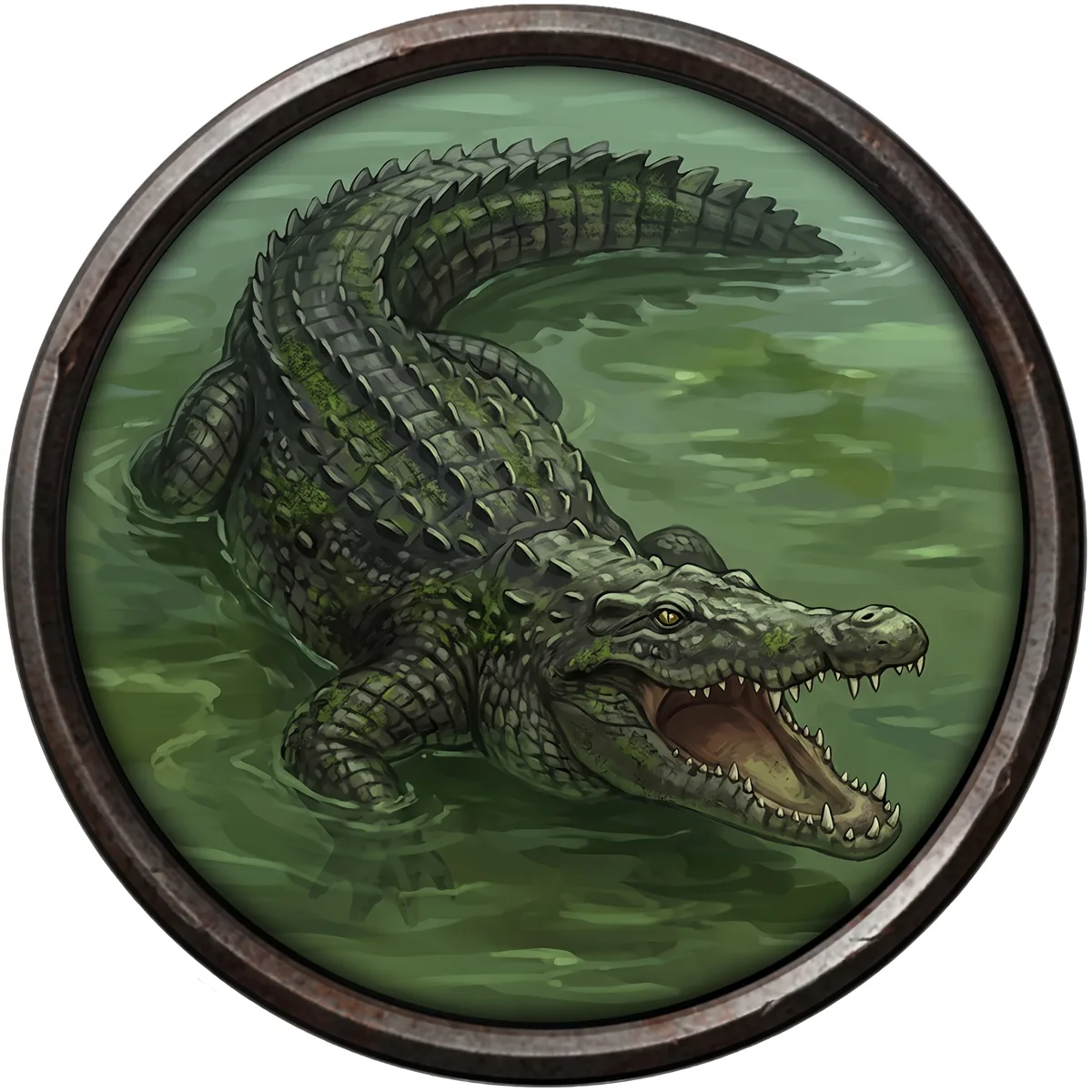 The next day, pushing hard to make up ground, Kaelen nearly stepped on a crocodile. Three
of them, hauled out on a slow side-stream off the Westrun. As a ranger he knew at once that
they were wrong: the Westrun runs fast and cold, and crocodiles want swamps and slow water.
Something upriver suited them.
He did not fight them. The fey had told the party not to harm the forest, and he took it seriously. He stamped his boots — crocodile-skin boots — and made himself terrible, and the biggest of the three looked at him for a long moment and lay back down. The party went around.
That same day Kaelen's hunting brought in a deer — eight days' food — and he split it round the party, most of it to Lyrique, who cooks.
Traveler's Rest
On the sixth day, at the end of the march, Kaelen found a hill by the river that was a little too regular to be a hill. A stone door stood ajar in its side, carved with worn elven knotwork. He stood at it and asked, in Elvish, "May we enter?" — and the door swung wider.
Inside was one room of fitted stone: a fireplace, empty sconces, dust, no damage and no sign that anyone had used it in centuries. Anyone who stepped over the threshold felt calm come over them. Quill's Detect Magic lit the whole place up — warding in the structure, a charm on the door, something kindled in the hearth. Kaelen asked the fireplace, in Elvish, for fire, and it gave him fire. It went out when asked. The door shut when asked. The party named the place Traveler's Rest and slept better in it than they had since the city. Quill woke with one level of fatigue instead of two. They have marked it for the road home.
The city across the river
On the seventh day the forest thinned to light woodland and rolling hills, and late in the afternoon the party came out on the south bank of a great bend in the Westrun and saw it.
A cliff of pale stone on the far bank, inside the bend, rising above the hills. Terraces cut into the cliff face, with doorways and windows and cut paths, and trees and vines growing out of all of it. A road climbing the cliff in five switchbacks. At the top, elven spires and buildings broken through by trees, and a cluster of towers — seven or eight, hard to tell at that distance, most with their tops fallen in. Below, a ford: paving stones on the riverbed, stone posts with holes through them where a ferry rope once ran, a paved road coming down to the water from the south and climbing away on the north.
It was, as near as anyone could judge, the size of Westmarch. The party camped among ruined walls on their own side of the river. The city had once stood on both banks.
The box under the stones
On watch that night Kaelen found rotted leather under a fall of worked stone, and inside it a box of stone and metal, latched, with runes on the lid that three centuries had barely touched. Quill read the lid from where he hovered — it was a title — and Identify told him the rest: a preservation charm, on the box and on what it held. Not a trap.
Inside was a book. Six inches by nine, an inch thick, worn brown leather, gold-leaf runes on the cover: The Basics of Rune-Smithing. Written in Elvish, about Vethara — the language of magic, the language cut into the Tess-Kydra — for an apprentice: what a rune is, how it is etched, how runes combine. Quill said it would take him a day to read and a good deal longer to learn.
He asked the obvious question. Was the Tess-Kydra made with runes? It was. The bowl is far beyond anything in the primer, he said — but this is where understanding how to make another one begins.
"Forgive me," said Kaelen, "I'm not the wizardly type — but would you consider what that bowl does to be basic?"
The storm
Rain before dawn. Kaelen read the sky and said a thunderstorm was coming, and an hour later it came, and brought branches down for most of the morning. Nobody was hurt. Kaelen spent the day building a haven in the south-bank ruins — a thing a ranger can do once a week, eight hours of work — while Quill read under cover and Lyrique sheltered him and the book, which has no protection at all once it is out of its box. The party slept the night safe in Kaelen's work.
Across the ford
At breakfast on the ninth day Lyrique looked up and saw something fly down out of the sky and drop into the open top of one of the towers, half a mile off or more. Man-sized at least, maybe bigger. Too far to say more. Kaelen's first thought was the dragon that supposedly lives out here. "I think a dragon would be bigger than a man," said Lyrique. They agreed to watch the towers.
The ford was waist-deep — deeper for Quill and Thalia — and paved for carts. Where the road left the water on the far side it passed under a stone arch with an inscription in Elvish, still legible:
No false word passes this line.
A former dock frontage ran a couple of hundred yards along the bank on either side. Kaelen read the arch and did not like it. "I feel like that carries more weight than just a general cultural norm." Nobody tested it. They walked under.
Quill set the party's course — "If we're looking for mage-built, look for the most arrogant place you can find" — which meant the towers. At the foot of the first switchback Kaelen found tracks. Small ones, bipedal, clawed, bootless, about Thalia's size — kobolds, by the look of them — some fresh, some older, going off along the base of the cliff rather than up the road. And large ones, the same kind of mark the trees had left in the camp, only bigger, a day or two old, that had come down the switchbacks and gone back up.
Nine days out of Westmarch, the party stood at the bottom of the road into Celindara.