The Broken Lintel
One morning on the switchbacks of Celindara. By noon the party had put the dead back to bed, read the city's own account of Westmarch, and been given leave to stay by something it never saw.
Here, rest
The road climbs the cliff in long, lazy switchbacks, and at the end of each one runs a flat terrace lined with houses cut from the cliff's own pale stone. Most of them are homes. Trees have come up through many of them and taken the roofs off. And about one house in six, as the party walked past, gave off something: a cold, and under the cold a feeling like sorrow.
Drakov worked out why. Every doorway has a stone lintel carved with two words, and the cold houses are the ones whose lintels have been cracked by roots. Quill read the words. They are Vethara — the language of his primer, the language on the bowl — and they say, as near as the language can be put into Common, Here, rest.
Vethara, he explained, is a language of statements. A carver does not ask the stone to do a thing; he states that it is so, and it stays so until something contradicts it. Here, rest, cut over a door and given power, would keep whatever was inside at rest. Asleep. Or — he was already looking at Drakov — dead, and staying that way.
"My first thought is permanent rest," he said. "Which then begs the question: if it's broken and it's cold — ghosts?"
Drakov suggested they look before deciding.
The house
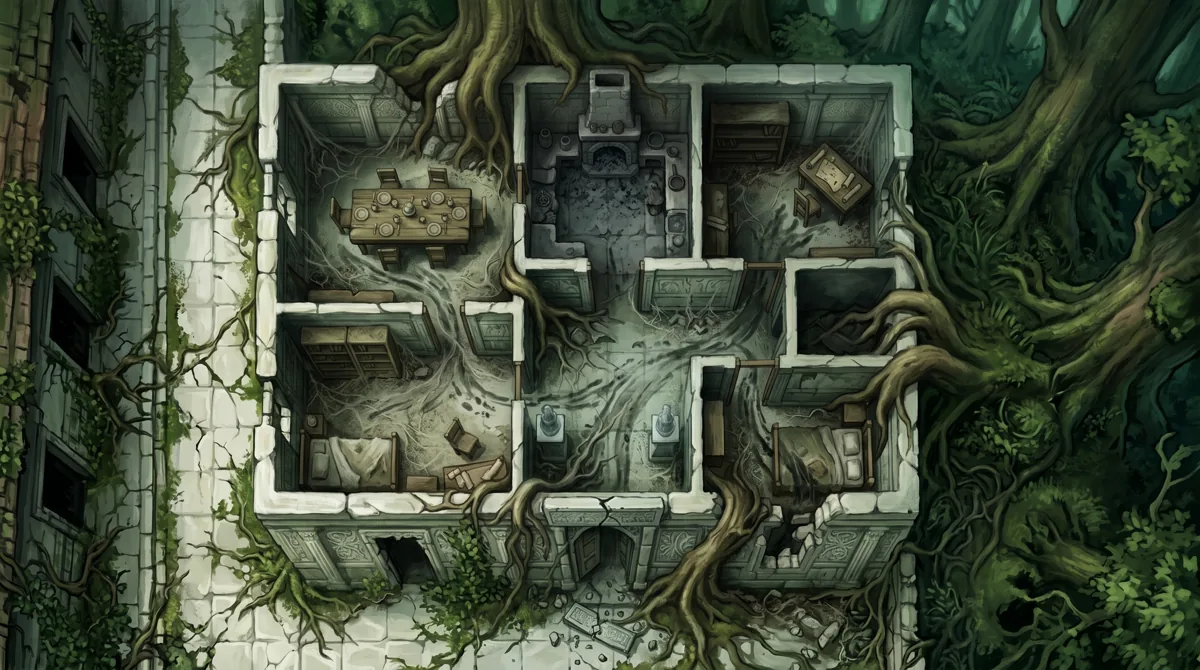
They picked a cold house with a cracked lintel and an open door. Inside: dim, dusty, roots through the walls, a foyer and a kitchen and a dining room, two bedrooms and a study, the furniture still standing and probably rotten. In the dust on the floor, marks — not feet, not hooves. Something had slid through. Lyrique, who turned out to be unexpectedly good at this, judged them a few days old. "Something lives here," she said. "It is probably out hunting right now. Unless it's watching us from the rafters."
They spread out. Quill began the slow version of Detect Magic and found a faint, broken thread of enchantment in the outer walls only. Kaelen turned over a kitchen of rust. Drakov went through the study desk and watched every scroll in it crumble at a touch — all but one leather-bound book, old Elvish, a hundred and forty pages, holding together if you were careful with it. And Thalia, in a bedroom, pushed on a nightstand until it collapsed and found under it a floor stone that had been lifted, and under that a hollow, and in the hollow an ivory box: a foot long, scrollworked in the elven style, yellow with age, and packed edge to edge with small bars of gold.
She showed Lyrique. "What does the greedy, selfish part say?"
"We should not tell anyone else about this."
Behind Thalia, a piece of the wall's shadow came away from the wall and reached for her, and the room went cold.
Three shadows
There were three of them — tall, thin, man-shaped once, no faces — and they came out of the walls of three rooms at once. Steel went through them with a kind of reluctance and did less than it should. Their touch was cold and took something out of you; Drakov, who took it twice, was left grey and swaying and only just on his feet. Light did nothing. Drakov's own cantrip blazed twenty feet of daylight across the room and the shadows simply stood in it. "I am a sun priest," he said, with some bitterness. It had to be the sun itself; they kept out of the patches of it that came through the roof.
Everyone did what they do. Drakov raised a hammer of force in the air and set it swinging and breathed fire down the hall. Thalia cut, stepped back out of reach, cut again, and finally put an arrow through one with her bow. Kaelen, who had announced going in that he does not fight ghosts, fought one with lightning on his sword every round until it stopped coming. And Lyrique, who does not attack things, looked a shadow in the place its face should have been and said "Imagine being dead," and it fell apart. "Imagine getting insulted to death," she said, delighted, and backed out of the room.
Quill was not in the fight. He had flown out to the door.
"I'm not running from the fight. I'm trying to solve it." The lintel was broken; the words were broken with it; he could not simply scratch them back into the stone. So he froze the crack full of ice and, with a knife, cut the inscription into the ice to complete it — one check of his craft, four rounds of work, twenty-four seconds. When he finished, the house changed. The cold went out of it. Whatever had been wrong with the walls came right. And the ice was already starting to run.
Kaelen killed the last one as Quill finished. "Look, guys. I killed the ghost. That's the first time this ever happened."
Quill flew back in and gave them, by his estimate, five minutes.
What it cost
Nothing, as it turned out. He checked himself afterwards and found no spell spent and nothing taken. He had not put power into the lintel; it was more, he said, like a channel that had been blocked, and he had cleared it, and the water was running again. For a while.
The gold
There were about a hundred bars in the box, each about a pound, the box itself a hundred pounds. Every bar was stamped with the same mark: seven round towers in a ring, a square in the middle, a line joining them. Quill knew it from his reading in the Archive. It is the mark of Celindara. The towers are the towers at the heart of the city — the ones with something living in them — and the square is a thing his sources called the Answering Stone, and told him nothing else about.
It was plain gold. Nothing magical in it; the city's own mint, as far as he could tell. Quill said they were desecrating a grave and should not take it. Lyrique pointed out that nobody puts beds in graves. Drakov pointed out there were no bones. Kaelen pointed out that if the whole city was a grave and everyone in it was dead and gone, no one would be upset if anything was missing. They took it — four ways, since Quill is the size of one bar — and Thalia kept the box.
The Measure of the Westrun
Kaelen reads Elvish, so the book went to him. Its title is The Measure of the Westrun, and it is the house-book of the people who ran the ford: the river measured from the city outward, two hundred years of entries in many hands. Quill read the first of them aloud.
Forty-four leagues down the river, at the last ford before the plain, the men have their market. They call it the West-march, meaning the edge of their own country, which tells you where they think the middle is. They build in timber and expect it to last. They pay in silver, promptly, and argue about weight.
That is Westmarch, four hundred years ago, as the elves saw it: a timber town that paid in silver. "We found gold in Celindara," Quill observed. "So it's possible that gold is found in the forest." Later entries told of the Rides, hunting ground south of the city, and below them the low country, where frog-folk live who "pay a rent to something older."
The last entry Quill read was signed in a hand called Coriveth, in the year 928:
The road to the ford is open. The kerbs say so on both sides, and I have walked it end to end this summer and found no gap. Twelve leagues of it are under the men's patrols now, and their captain at the timber fort has asked for a copy of the mile-marks. Sent.
The timber fort is Harrow Keep. In 928 the elves of Celindara were walking the road to Westmarch and posting maps to Harrow's captain. In 941 — Kaelen had the date right this time, and the letter by heart — Harrow wrote that the war had ended in a bargain made under duress. Thirteen years. Nobody at the table knew who Coriveth was.
Somewhere in the middle of the dating, the DM laid out the war as the histories have it — 920 it began, five years of confusion and retreat, five of desperate defence, five of grinding stalemate, five of being driven back until the bargain — and said, in passing, that by the second five years the defenders had worked out what they were fighting and had a name for it. Whatever was controlling the forest, they called the Greenheart.
The party had never heard the word.
The top of the cliff
An hour's rest on the terrace, looking down at the river, Drakov knitting himself back together and Quill reading. Then twenty more minutes of switchbacks, and the top.
A road ran straight away from the cliff edge, big cut stones, broken and overgrown but mostly there, ruined white buildings on both sides, and a quarter of a mile along it an open space and the towers. The city was built in a circle around that space; they were standing on one of its spokes, and ring-roads crossed it as they walked. In the dirt on the road Kaelen found the kobold tracks again, and the big tree-thing, and something new: a cat, lion-sized or near it. All of it within the week. "Heads on a swivel."
Drakov thought the flyer must be the dragon from Harrow Keep, if its kobolds were here. Nobody had thought it looked dragon-sized — though, as the DM observed, they know Percival, and he is not very big. Kaelen's thought was worse: the dragon has not been seen in a century. It could have had children.
Quill wanted eyes in the air that were not his. He has a spell that brings a familiar, a small creature bound to him, and a small creature over the court would see more and risk less than any of them. It takes an hour. Kaelen would not have him do it in the middle of the street, so they found an overgrown shop with its walls still standing and most of its roof gone, and Quill sat down six inches tall in a chalk circle and began.
The voice
A quarter of an hour in, the others heard it: heavy footsteps, and branches and leaves being pushed aside, coming down the road toward them. Bump. Bump. Something large. It came on, and came on, and stopped outside the wall where they were hiding.
Then it spoke — a deep voice, in Elvish, which Kaelen and Quill and Lyrique understood:
"The city is held. You are counted: five, out of the east. State what you intend here. Stated things bind, on this ground."
Kaelen remembered the arch. No false word passes this line. He let out a breath and answered it in Elvish, with the truest thing he could say in three words.
"We seek knowledge."
"Knowledge you may have."
The footsteps went away up the road.
"Well," said Kaelen, when they had gone. "That went better than it could have."
Quill is still casting. Whatever comes to him when he finishes, the party has not yet seen, and neither have they seen the thing that holds the city — only heard it decide to let them stay.